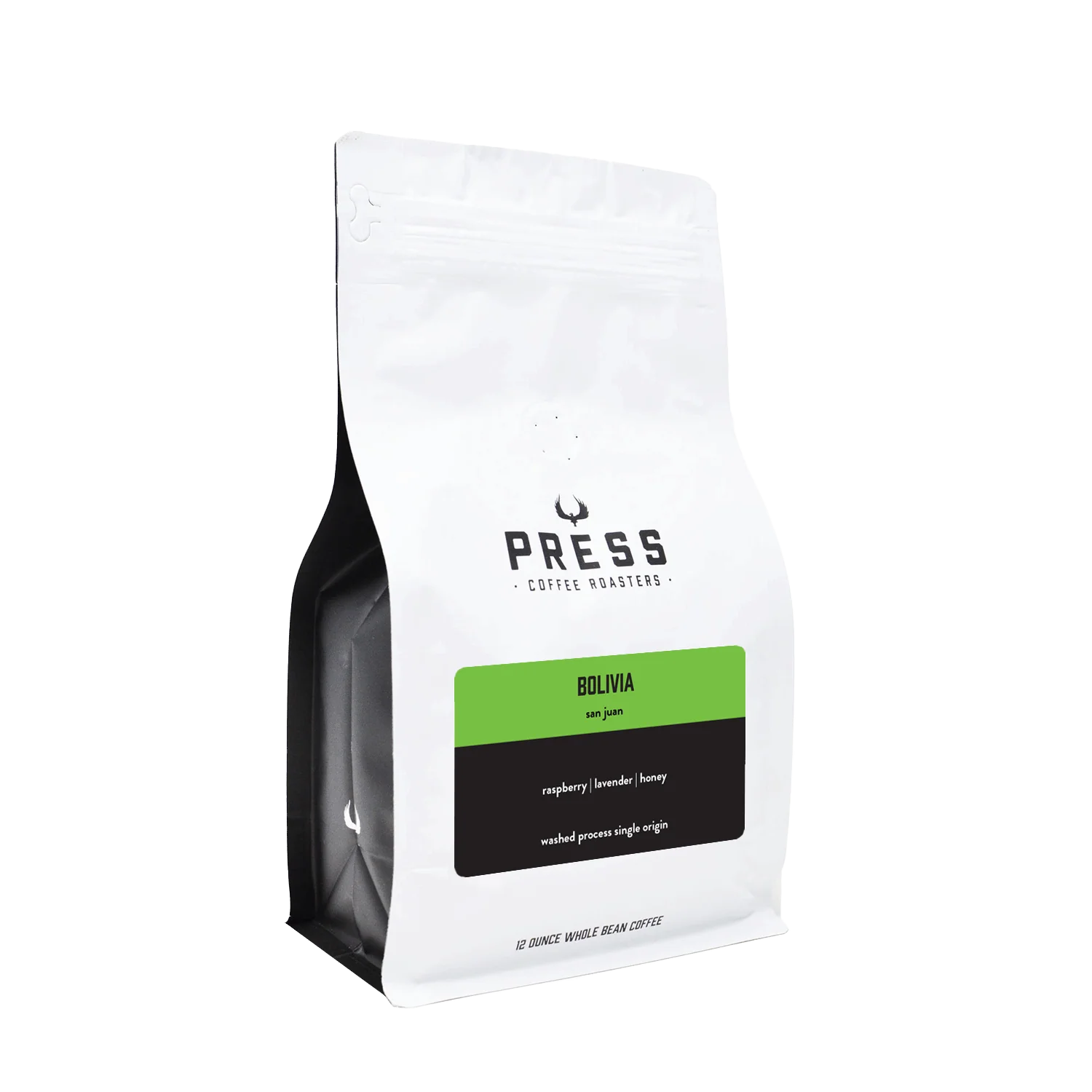
Bolivia San Juan Coffee
ORIGIN
Farm: 33 farms organized around Cooperativa Agricola
Region: Caranvi, La Paz, Bolivia
Process: Washed
Variety: Typica, Caturra, Catuai
Elevation: 1500 masl
Certifications: Organic Certified
FARM
Formed in 1974, the Cooperativa Agricola Cafetalera started with 40 farmer members across Caranavi with the goal of supporting small family farms and organic, chemical-free farms. By the mid-2000’s, Bolivia was hosting annual Cup of Excellence competitions and there was a high level of international development interest in the Yungas coffee center, of which Caranavi is the center.
However, productivity declined tremendously from 2006-2017 due to aging trees and falling investment. That year, Felix Chambi Garcia joined the organization and with it he brought over 16 years of specialty coffee experience as a copper and member of various other Bolivian cooperatives. Since then, the total production, overall quality, and diversity of coffees has increased significantly.
Bolivia is South America's only landlocked coffee producing country and is the smallest exporter of coffee on the continent. The quality of that coffee, however, is hardly lacking in diversity or beauty. Bolivia’s terrain and geography is gifted for arabica production, particularly throughout its greater Yungas region (Yungas is Aymara for "warm lands"), whose mountain ranges connect the low and humid Amazonian basin to the dry Andean altiplano above.
Caranaví's landscape is steep, cloudy, rugged, and remote with natural forest making up more than 90% of its territory. Coffee farms in this high and tropical climate tend to be well-managed but small. Their greatest challenge is isolation.
Biodiversity, soil health, elevation, and progressive leadership in San Juan all work undeniably in favor of small farmers seeking sustainable livelihoods with coffee. With each and every Bolivian coffee, especially the best ones, is one of the most strenuous overland transits in the coffee world, passing elevations of 4000 meters over the top of the Andes and west to the port of Arica on Chile’s coast. The country’s low production, select few producer groups in specialty coffee, and formidable logistical challenges, means each successful arrival is something to be cherished.
PROCESS
San Juan relies on individual farmers to process their own coffee and Felix Chambi Garcia has made quality control central to the coop’s operations. Their lab in Alto Cochabamba serves as the central quality control point for all lots and exportations. Harvesting has its own protocols as well.
Coffee cherry is:
- Picked exclusively ripe
- Floated to sort by density
- Depulped on small mechanical depulpers
- Fermented 18-24 hours
Once fermentation is complete the parchment is washed clean in narrow basins and sundried on raised screen beds.
Original: $19.00
-65%$19.00
$6.65Product Information
Product Information
Shipping & Returns
Shipping & Returns
Description
ORIGIN
Farm: 33 farms organized around Cooperativa Agricola
Region: Caranvi, La Paz, Bolivia
Process: Washed
Variety: Typica, Caturra, Catuai
Elevation: 1500 masl
Certifications: Organic Certified
FARM
Formed in 1974, the Cooperativa Agricola Cafetalera started with 40 farmer members across Caranavi with the goal of supporting small family farms and organic, chemical-free farms. By the mid-2000’s, Bolivia was hosting annual Cup of Excellence competitions and there was a high level of international development interest in the Yungas coffee center, of which Caranavi is the center.
However, productivity declined tremendously from 2006-2017 due to aging trees and falling investment. That year, Felix Chambi Garcia joined the organization and with it he brought over 16 years of specialty coffee experience as a copper and member of various other Bolivian cooperatives. Since then, the total production, overall quality, and diversity of coffees has increased significantly.
Bolivia is South America's only landlocked coffee producing country and is the smallest exporter of coffee on the continent. The quality of that coffee, however, is hardly lacking in diversity or beauty. Bolivia’s terrain and geography is gifted for arabica production, particularly throughout its greater Yungas region (Yungas is Aymara for "warm lands"), whose mountain ranges connect the low and humid Amazonian basin to the dry Andean altiplano above.
Caranaví's landscape is steep, cloudy, rugged, and remote with natural forest making up more than 90% of its territory. Coffee farms in this high and tropical climate tend to be well-managed but small. Their greatest challenge is isolation.
Biodiversity, soil health, elevation, and progressive leadership in San Juan all work undeniably in favor of small farmers seeking sustainable livelihoods with coffee. With each and every Bolivian coffee, especially the best ones, is one of the most strenuous overland transits in the coffee world, passing elevations of 4000 meters over the top of the Andes and west to the port of Arica on Chile’s coast. The country’s low production, select few producer groups in specialty coffee, and formidable logistical challenges, means each successful arrival is something to be cherished.
PROCESS
San Juan relies on individual farmers to process their own coffee and Felix Chambi Garcia has made quality control central to the coop’s operations. Their lab in Alto Cochabamba serves as the central quality control point for all lots and exportations. Harvesting has its own protocols as well.
Coffee cherry is:
- Picked exclusively ripe
- Floated to sort by density
- Depulped on small mechanical depulpers
- Fermented 18-24 hours
Once fermentation is complete the parchment is washed clean in narrow basins and sundried on raised screen beds.